Loading token details...
Loading in progress XRP
XRP 0.14% 0.002127(24h)
1H
1.66%
7D
15.52%
30D
3.34%
60D
38.59%
90D
45.59%
Low: 0.020
High: 0.020
1H
1.66%7D
15.52%30D
3.34%60D
38.59%90D
45.59%Green Days
All Time High
All Time Low


 0x1d2f...c60dbe
 Market Cap
N/A
N/A
N/A
N/A
The live price of XRP is at 1.52 with 24 hours volume of 4.90B. The chart above shows is currently by 1.66% in the past hour and 0.14% by since yesterday. The total circulating supply of XRP token is 62,879,209,849.00 and the max supply is 100,000,000,000.00 .
Over the last 24 hours, XRP token experienced trading activity amounting to 4.90B. The decentralized exchange (DEX) volume accounted for 0.020, while centralized exchanges (CEX) stood at 4.90B.
XRP (XRP) token reached an all-time high of 3.84 on and an all-time low of 0.002802 on .
Dropping -60.45% from its ATH is a significant retracement, yet a rise of 54126.47% from its ATL projects robust recovery.
XRP is a deflationary cryptocurrency with a max supply of 100,000,000,000.00 with 62,879,209,849.00 in circulation.
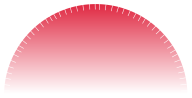
Sell
Neutral
Buy
Sell
Neutral
Buy
Sell
Neutral
Buy


Please wait data is Loading...
 Exchange Exchange | Price | Pairs | 24h Volume | Trust Score |
|---|---|---|---|---|
XRP is the native cryptocurrency of the XRP Ledger, a fast, low-fee Layer 1 blockchain developed by Ripple Labs to improve global payments. First launched in 2012, XRP was designed to serve as a bridge currency for cross-border transactions, offering near-instant finality and minimal cost—features that have made it one of the most adopted digital assets in the banking and fintech world.
Created by Ripple co-founders Chris Larsen and Jed McCaleb, the XRP token aimed to solve the inefficiencies of traditional financial systems like SWIFT, particularly around international remittances. With a fixed supply of 100 billion XRP, no mining, and rapid settlement times (3–5 seconds), XRP offers a scalable alternative to legacy networks and has been integrated into Ripple’s On-Demand Liquidity (ODL) solution used by over 1,000 global institutions.
XRP is also gaining traction as infrastructure for CBDCs, stablecoins like RLUSD, and tokenized assets. Its recent regulatory clarity in the U.S. after the SEC lawsuit—where XRP was ruled not to be a security for public trading—has further solidified its position. As of today, XRP continues to rank among the top cryptocurrencies by market cap, with strong daily volume on platforms like Upbit, and ongoing relevance in both crypto and traditional finance ecosystems.
Whether tracked via XRP price charts, Ripple news, or XRP/USD trading pairs, XRP remains one of the most closely watched digital assets globally.
XRP stands out due to its ultra-fast transaction speed (3–5 seconds), low fees (fractions of a cent), and a consensus mechanism that avoids energy-intensive mining. Unlike many cryptocurrencies, XRP was pre-mined with a fixed supply of 100 billion tokens, making it resistant to inflation. Its real-world utility has been validated by adoption among banks, payment providers, and governments, including for CBDC pilots and stablecoin issuance.
How Does XRP Work?
XRP runs on the XRP Ledger (XRPL), a Layer 1 blockchain that uses a consensus protocol known as the Ripple Protocol Consensus Algorithm (RPCA). This is not Proof-of-Work or Proof-of-Stake. Instead, it relies on a group of trusted validator nodes that agree on the state of the ledger every few seconds. This unique mechanism ensures energy efficiency and high transaction throughput.
A pivotal chapter in XRP's history began on December 22, 2020, when the U.S. SEC sued Ripple Labs, alleging it conducted an unregistered securities offering by selling over $1.3 billion in XRP tokens. The SEC argued XRP qualified as a security under the Howey Test.
The lawsuit triggered a sharp downturn in the XRP price and wiped billions off its market cap. Major U.S. exchanges like Coinbase, Binance.US, and Kraken delisted XRP, cutting off retail access in the U.S. Ripple’s American partnerships stalled, though XRP crypto adoption outside the U.S.—notably in Asia and Latin America—remained strong. Platforms like Upbit and Bitstamp continued listing XRP, and RippleNet usage persisted globally.
On July 13, 2023, Judge Analisa Torres of the U.S. District Court for the Southern District of New York issued a landmark split ruling:
The ruling marked a partial victory for Ripple and the broader crypto market. It introduced legal nuance: a token's classification depends on how it is sold, not just what it is. Following the decision, XRP surged over 70%, and major platforms like Coinbase, Kraken, and Gemini promptly relisted XRP, boosting market confidence.
Though the SEC pursued further penalties into early 2024, the case officially concluded in March 2025, when Ripple and the SEC reached a settlement:
This resolution ended the nearly five-year lawsuit, granting Ripple and XRP much-needed regulatory clarity in the U.S.
The outcome was broadly viewed as a regulatory win for Ripple and the crypto space. With legal uncertainty lifted, U.S. institutions could re-engage with XRP token integrations, and global exchanges saw renewed interest in XRP trading.
As of August 2025, XRP is firmly positioned among the top 3 cryptocurrencies by market cap, with high daily trading volume across major platforms like Upbit, Binance, and Coinbase. Investor sentiment around Ripple XRP news remains strong, and the XRP price today reflects renewed confidence and sustained global adoption.
XRP (Ticker: XRP) is one of the longest-standing cryptocurrencies, launched by Ripple Labs on August 4, 2013. At its initial listing price of $0.0059, XRP offered early investors over 569x returns. Unlike Bitcoin, XRP was pre-mined with a fixed supply of 100 billion tokens, making it deflationary by design.
The XRP crypto was developed by Chris Larsen, Jed McCaleb, and David Schwartz to solve inefficiencies in cross-border payments. Built on the XRP Ledger (XRPL)—a fast, energy-efficient Layer 1 blockchain—it enables transactions in just 3–5 seconds, with extremely low fees, making it ideal for global remittances and real-time liquidity.
Between 2013 and 2019, Ripple raised over $300 million across multiple funding rounds. Key investors included IDG Capital, Blockchain Capital, DCG, Accenture Ventures, and CME Ventures. Notable rounds include:
This funding allowed Ripple to expand globally, onboard over 1,000 financial institutions, and drive real-world adoption of XRP token via RippleNet and On-Demand Liquidity (ODL).
XRP (Ripple) is widely available across leading global crypto exchanges, both for spot and derivatives trading. You can buy XRP using USDT, USD, EUR, FDUSD, USDC, BTC, and even stablecoins like RLUSD, depending on the platform.
Binance, Coinbase Exchange, Bybit, Bitget, OKX, Kraken, LBank, WEEX, HTX, BitMart, Gate.io, MEXC, KuCoin, Bitstamp, XT.COM, Crypto.com Exchange, Phemex, Bitrue, Toobit, CoinW, Bitbank, Zoomex, Ourbit, DigiFinex, WhiteBIT, Bullish, GroveX, CoinEx, Azbit, Biconomy.com, KCEX, Bitvavo, Bitunix, BitKan
Hardware Wallets:
Ledger, Keystone, SafePal, OneKey
Mobile & Software Wallets:
Trust Wallet, MetaMask, TokenPocket, iToken Wallet, Assure Wallet, SafePal, Coinhub, SimpleHold Wallet, Atomic Wallet, Coin Wallet, Coin98, Halo Wallet (KuCoin Wallet), Wirex Wallet, XDEFI Wallet, Venly, Coinomi Wallet, BitPay, Bitcoin Wallet, Frontier Wallet, Gem Wallet, Blocto Wallet, Conio Wallet, FxWallet, Magic Wallet, Omni Wallet, ONTO Wallet, Uniswap Wallet
Exchange-Integrated Wallets:
Binance Wallet, OKX Wallet
Live Token Dashboard & Analytics
Track this token’s real-time pricing, market indicators, supply metrics, exchange activity, and technical analysis insights. The dashboard presents accurate market dynamics to help evaluate performance. If the data is inaccurate, Notify Us



 Track Your Portfolio
 Website
 White Paper
 Source Code


